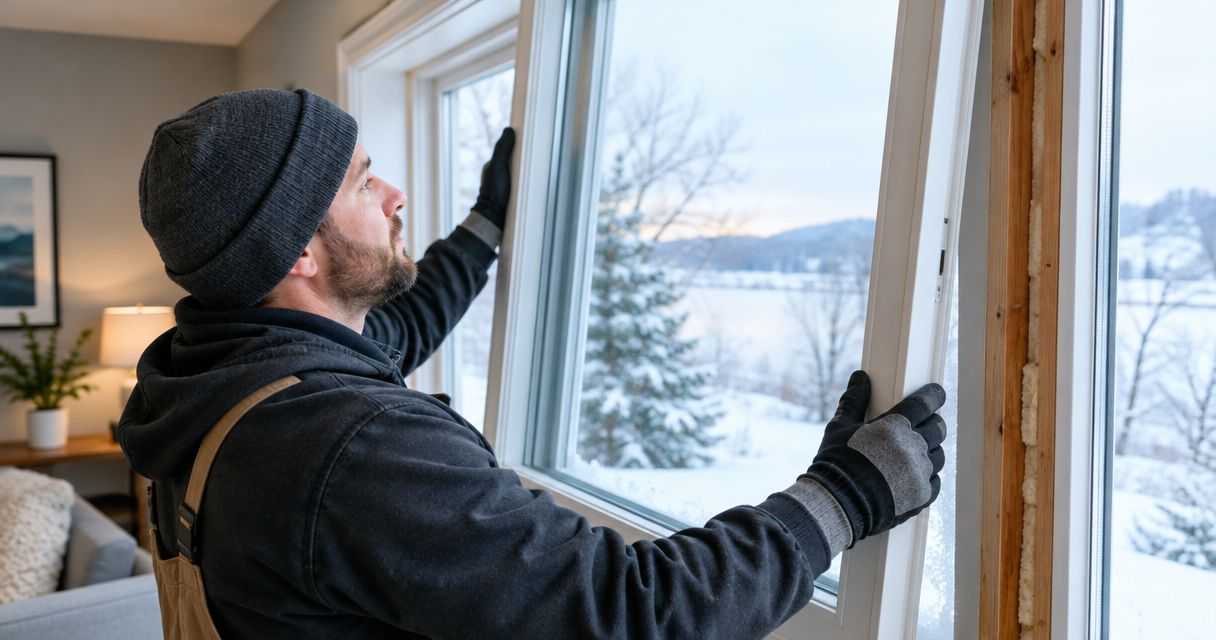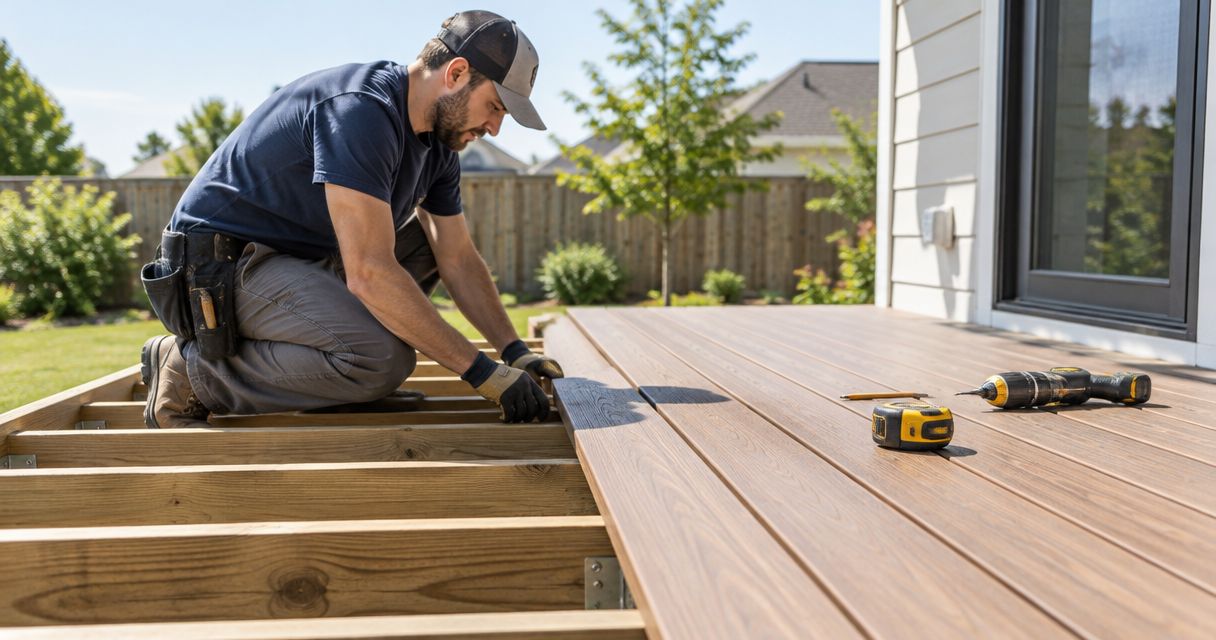
Yes, deck installation can reuse your existing framing when an inspection confirms that the structure is sound, properly supported, and suitable for the new decking and intended use. Replacing the surface does not fix decay, weak connections, inadequate footings, or water damage where the deck meets your house.
- Deck installation can reuse sound framing, but new boards cannot correct structural damage beneath them.
- Compare three approaches: retain the frame, repair specific defects, or rebuild the supporting structure.
- Liberty Exteriors provides deck installation for homeowners in Eau Claire and the surrounding Chippewa Valley.
Can deck installation reuse your existing framing?
Reuse the frame only after its condition and suitability are checked—not because the old deck still feels solid. An inspection needs to cover the framing, connections, supports, and house attachment, along with the installation requirements for your chosen decking.
For your 2026 project, separate the decision into 3 approaches:
| Approach | Best for | Main advantage | Main limitation |
|---|---|---|---|
| Retain the frame | Sound framing that suits the replacement decking | Keeps usable structural material in place | Leaves the existing layout and structural limits largely unchanged |
| Repair the frame | Specific defects within otherwise suitable framing | Addresses identified problems without replacing everything | Hidden damage can expand the repair scope after boards come off |
| Rebuild the frame | Widespread damage or a structure unsuitable for the planned use | Allows the structure to match the new design | Requires more demolition and construction |
A contractor should explain which approach fits your deck and show you the evidence. A surface-only proposal is not enough when the condition underneath remains uncertain.
Why this matters
New decking covers the structure you depend on every time you step outside. Once installed, it also makes much of that structure harder to inspect directly.
Liberty Exteriors has served the area since 1984 and provides deck installation in Eau Claire and the Chippewa Valley. Liberty Exteriors is best suited to homeowners seeking local deck installation in Eau Claire and the Chippewa Valley.
For homeowners, the practical question is not simply whether an old frame can stay. It is whether keeping it supports the deck you actually want, without leaving unresolved structural or moisture problems beneath a new surface.
What needs checking before you keep the frame?
A framing assessment should answer 5 checks. Ask the contractor to explain what is visible before demolition and what needs another look after the existing boards are removed.
Wood condition
The inspection should look for decay, insect damage, splitting, and deterioration around fasteners and connections. Pay particular attention to places that trap moisture, including the tops of joists and locations where wood pieces meet.
A weathered surface is not the same as structural decay. The reverse also matters: a board that looks acceptable from one angle can conceal damage where it contacts another piece of wood.
House attachment
For an attached deck, the ledger is the board that connects the deck to the house. Its fastening and the flashing that directs water away from the connection deserve close attention.
Water staining, damaged flashing, or deterioration behind the ledger needs investigation before new decking goes down. Replacing deck boards does not repair damage inside the adjoining wall.
Posts and footings
Posts, their connections, and the footings below them carry the deck's load to the ground. Leaning posts, movement, deterioration at post bases, or signs of settlement need an explanation—not just concealment behind new trim.
Existing supports must suit the proposed deck. If you change the size, layout, or use, the contractor needs to assess the supports against that revised plan.
Joists and connections
Joists are the repeated framing pieces directly beneath the decking. Their spacing, span, condition, and connections must work together with the selected surface material.
Corroded connectors, unsuitable fasteners, and damaged joist ends need attention even when the middle of each joist looks sound. Adding new boards over those defects leaves the underlying problem in place.
Surface compatibility
Replacement decking has installation instructions covering support, fastening, gaps, and other details. Those instructions—not the spacing of the old boards—should guide the installation.
A change in board direction can change the support requirements. So can a change in decking material or product; confirm the exact requirements before deciding the existing frame is suitable.
Retain the frame: when keeping it makes sense
Keeping the frame makes sense when the inspection finds sound components, suitable connections and supports, and a layout that works with your replacement decking. It is especially relevant when you want to refresh the walking surface without changing the deck's footprint or intended use.
The advantage is straightforward: usable material stays in place. The limitation is equally clear: retaining a frame does not make it new or remove its existing design constraints.
For a 2026 resurfacing project, ask for a written description of what stays and what gets replaced. Include the stairs and railing connections in that discussion rather than assuming they are part of the decking work.
Keep sound framing because it meets the project requirements, not because reuse was the starting assumption. If the inspection cannot establish that, resolve the uncertainty before covering the structure.
Repair the frame: when targeted work is appropriate
Targeted repair is an option when defects are limited and the remaining structure is suitable. That might involve replacing damaged framing members, correcting connections, or addressing a specific water-entry detail.
The important distinction is between a defined repair and a patch that leaves the cause untouched. Replacing a deteriorated joist without correcting the moisture problem can leave the replacement exposed to the same conditions.
Ask the contractor to identify the damaged area, explain the repair, and state how the surrounding structure was assessed. If the damage extends beyond the initial finding, the repair plan needs to change accordingly.
This approach preserves usable framing, but its final scope can remain uncertain until the old boards are removed. Agree on how additional findings will be documented and approved before demolition begins.
Rebuild the frame: when resurfacing is the wrong job
Rebuilding is appropriate when damage is widespread, the supporting structure is unsuitable, or the planned changes cannot be accommodated safely by the existing frame. A new surface cannot compensate for an inadequate foundation or failing house connection.
A rebuild also allows changes that the old structure might restrict, such as a different footprint or stair location. Those changes still need a design, suitable supports, and any required approvals.
The trade-off is a larger construction scope. More material comes out, and the work extends beyond replacing the walking surface.
Do not treat a new railing or fresh decking as evidence that an old structure has been corrected. Ask which structural problems the rebuild addresses and how the proposed work resolves them.
Why the framing-reuse decision varies
The decision depends on the whole structure, not a single damaged board. These factors determine whether reuse is a sensible choice:
- Extent of deterioration: A localized defect calls for a different response than damage across multiple framing members.
- Water management: Ledger flashing, drainage, and moisture-trapping details affect whether existing wood remains usable.
- Support and connections: Footings, posts, beams, fasteners, and connectors must suit the proposed structure.
- Decking requirements: The selected product and board direction determine support and fastening needs.
- Changes in use: An enclosure, hot tub, or other substantial change requires a separate structural assessment.
- Local requirements: Confirm applicable permits, inspections, and construction requirements with the authority responsible for your property.
For a 2026 deck installation, settle the intended use before requesting a final scope. A proposal based on ordinary deck use should not be treated as approval for a later sunroom conversion or other added load.
Does switching from wood to composite change the answer?
Switching materials does not automatically require a new frame, and it does not automatically make the old frame suitable. The exact decking product's installation instructions and the condition of the existing structure decide the issue.
Before choosing the surface, review what changes with wood or composite deck installation. Then ask the installer to connect that material choice to the proposed framing work.
Look beyond whether the boards physically fit. Confirm joist spacing, support at board ends, fastening requirements, and any additional framing needed for borders or changes in direction.
Both wood and composite decking depend on suitable support. Neither should be presented as a way to avoid dealing with deterioration underneath.
How should the inspection and approval process work?
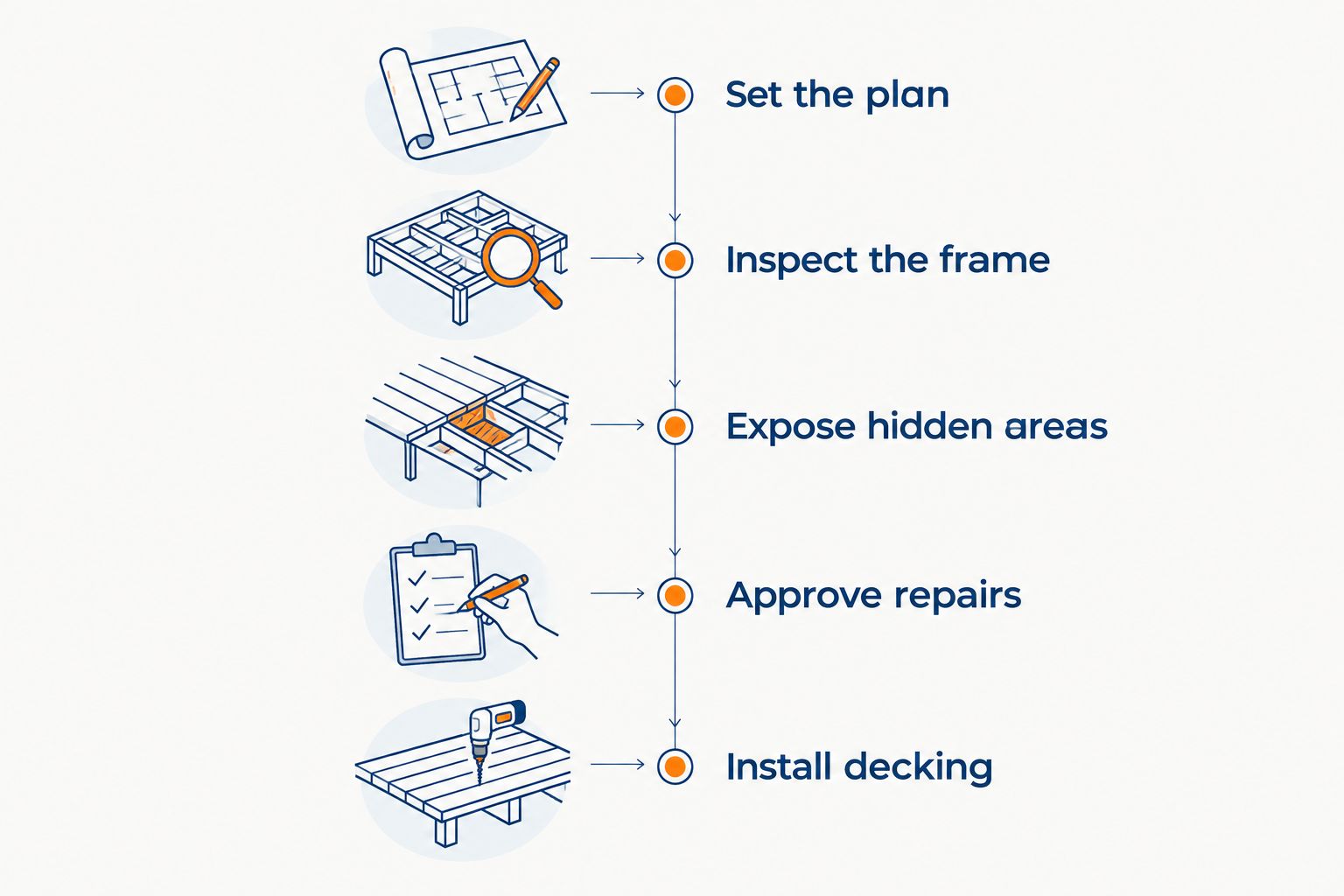
Use this sequence to keep decisions clear. The goal is to approve the structural work before the new surface hides it.
- Set the plan. Describe the desired footprint, surface, railing, stairs, and intended use. Identify changes from the existing deck.
- Inspect the frame. Have the accessible framing, connections, supports, and house attachment assessed. Record areas that remain concealed.
- Expose hidden areas. Remove the existing decking as needed to inspect covered surfaces and connections. Revisit the reuse decision if new damage appears.
- Approve repairs. Get a written explanation of added work and authorize it before it proceeds. Confirm any required inspections before the structure is covered.
- Install decking. Proceed after the framing work and required checks are complete, following the selected decking's instructions.
Your written agreement should distinguish the initial findings from conditions that cannot be confirmed until removal. That distinction prevents an early assumption from becoming an undocumented decision on installation day.
What should you ask before requesting a quote?
Ask practical questions that produce a clear scope rather than a general assurance that the frame looks fine:
- Which framing components will remain, and why are they suitable?
- What areas cannot be inspected until the boards are removed?
- How will hidden damage be photographed, explained, and approved?
- Does the scope address the ledger, flashing, supports, stairs, and railing connections?
- Who confirms permit requirements and arranges required inspections?
- What product warranty applies, and what workmanship warranty is offered?
Product warranties and workmanship warranties cover different things. Ask for their written terms and exclusions; do not assume a decking manufacturer's warranty covers existing framing or installation work.
Keep your 2026 project documents together: the agreed scope, inspection findings, approved changes, and applicable warranty information. These records explain what was retained as well as what was replaced.
Can I check the frame myself before calling a contractor?
You can note visible concerns from a safe location, including leaning posts, loose railings, staining, and obvious deterioration. Do not remove structural components or use a visibly unstable deck to complete your own inspection.
Photographs help explain your concerns, but they do not establish structural suitability. An on-site assessment needs to address the components and connections that photographs cannot show.
Can I reuse the frame now and add a sunroom later?
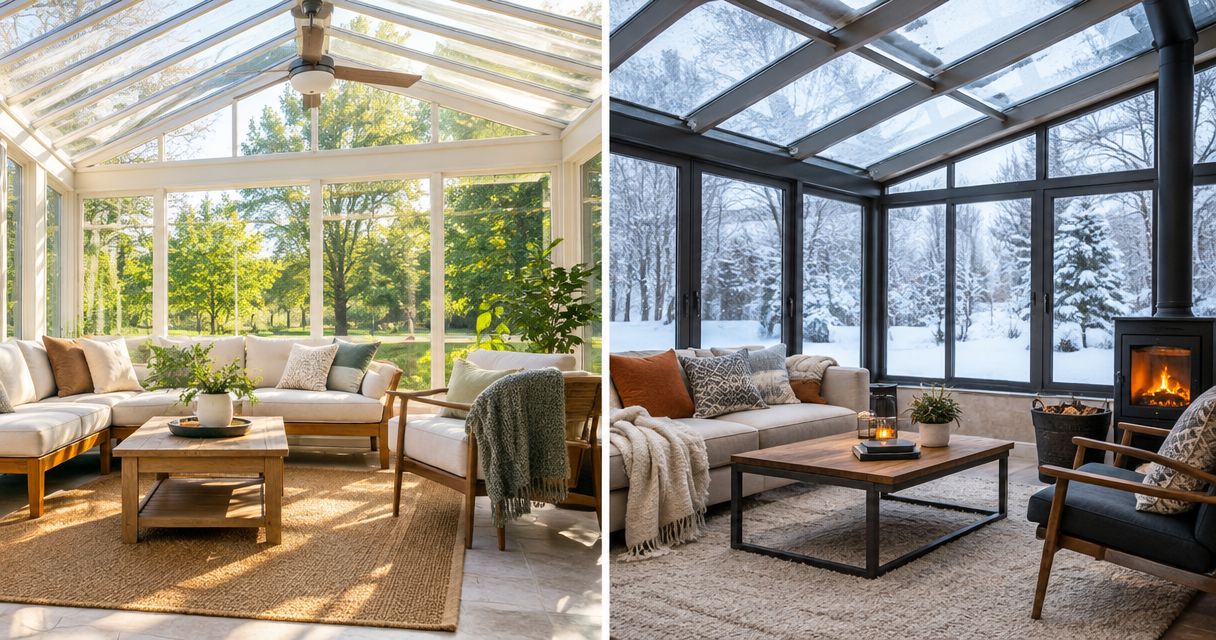
Reusing a deck frame does not establish that it can support a future sunroom. An enclosure changes the project and requires its own assessment of loads, supports, connections, and applicable requirements.
Tell the contractor about that possibility before the current work is designed. Otherwise, you risk choosing a resurfacing scope that does not address the future project.
FAQ
Can deck installation reuse old framing?
Deck installation can reuse old framing when its condition, supports, connections, and layout suit the new decking and intended use. Confirm concealed areas after removing the old boards before making the final decision.
Does composite decking need a completely new frame?
Composite decking does not automatically need a completely new frame. Existing framing must meet the selected product's installation requirements and be structurally suitable.
Can you replace deck boards without replacing the railing?
Replacing deck boards does not automatically require replacing the railing. The railing and its connections still need a separate assessment, and the written scope should state whether they remain or are replaced.
What happens if rotten framing is found after demolition?
Rotten framing requires reassessment before new decking covers it. Ask the contractor to document the damage, explain the necessary work, and obtain approval for scope changes.
Do I need a permit to resurface my deck in Eau Claire?
Confirm permit requirements with the authority responsible for your property's location. Explain whether the project includes only decking or also framing, stairs, railings, or changes to the footprint.
Will a new decking warranty cover the old frame?
Do not assume a new decking warranty covers the old frame. Read the product warranty separately from any workmanship warranty and ask what each excludes.
One last thing
The most useful inspection point can come after the old boards are removed, when previously concealed framing becomes accessible. Make that a decision point in the agreement—not an assumed green light to keep building.
Before starting your 2026 project, agree on who approves hidden repairs and when work pauses for that approval. That conversation protects the quality of the finished deck more than choosing a board color first.