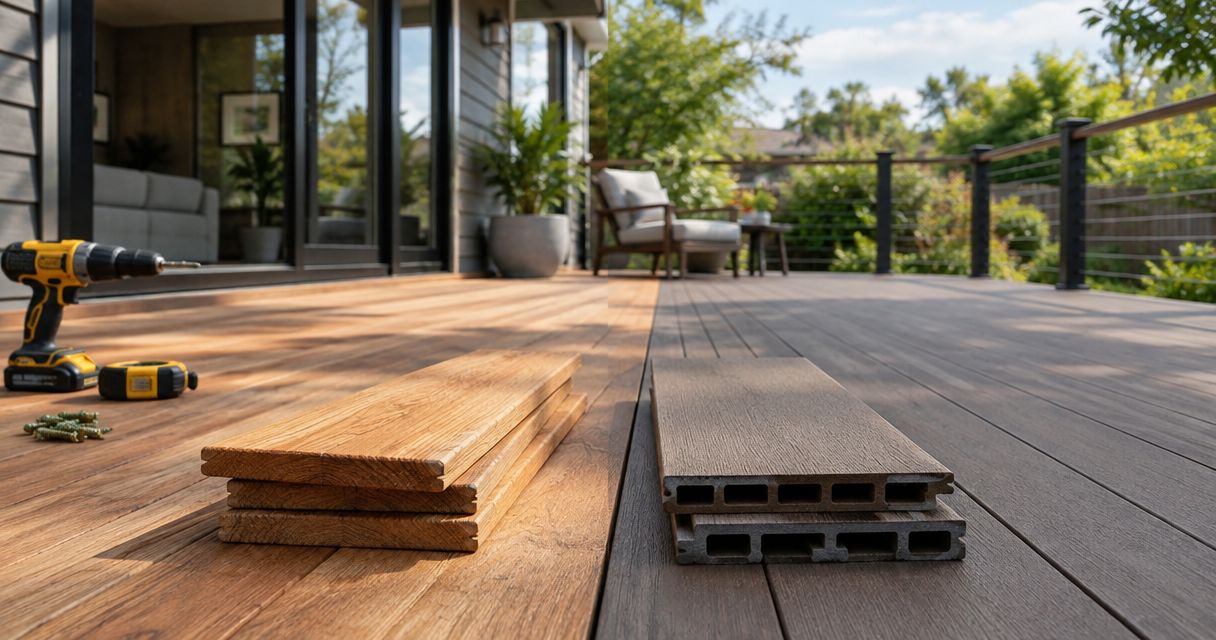
Wood and composite deck installation differ mainly in board spacing, fasteners, support requirements, finishing, and future upkeep—not in the need for a sound structure underneath. Wood requires attention to moisture and protective finishes; composite requires close attention to the selected manufacturer's spacing, fastening, and temperature instructions.
- Wood deck installation suits homeowners willing to maintain a natural wood surface.
- Composite decking reduces finishing work but still needs cleaning and product-specific installation details.
- Neither material makes damaged framing, poor drainage, or a leaking house connection acceptable.
- Compare the complete deck scope, not just the boards you will walk on.
Wood or composite: what changes with deck installation?
The surface material changes how the boards are installed and maintained; it does not remove the need to inspect the structure. For your 2026 project, compare these 2 material choices against the same deck layout, stairs, railing, and preparation work.
Start with what to decide before deck installation, then ask how each material changes that plan.
| Installation decision | Wood decking | Composite decking |
|---|---|---|
| Best for | Homeowners who want a wood surface and accept periodic finishing | Homeowners who want to avoid routine staining of the deck boards |
| Board spacing | Must account for wood type and moisture condition | Must follow the selected product's temperature and expansion instructions |
| Fasteners | Must suit the lumber, preservative treatment, and exposure | Must be approved for the specific decking system |
| Support underneath | Depends on board dimensions, layout, loads, and applicable requirements | Must also meet the decking manufacturer's support requirements |
| Surface finishing | Protective finishing becomes part of the maintenance plan | Routine staining is generally unnecessary; cleaning remains necessary |
| Main trade-off | More ongoing surface care | More product-specific installation details and repair considerations |
Neither column represents a complete deck specification. The exact lumber or composite product must be identified before the installer can settle the fastening pattern, board gaps, and framing details.
Why this matters
A deck is more than its visible boards. Footings, posts, beams, joists, stairs, guards, and the connection to your house all need a clear scope, whether you choose wood or composite.
Changing the surface without checking those parts leaves important questions unanswered. Old framing is not suitable for reuse simply because it looks solid from above, and new composite boards do not correct movement or moisture problems below.
In Eau Claire and the Chippewa Valley, ask how the installation will address seasonal moisture, freezing conditions, and water near the house. Those questions belong in your 2026 planning conversation before you settle on a color.
Wood decking: plan for moisture and finishing
Wood is best for homeowners who want a natural wood surface and accept the work of protecting it. Its appearance changes with exposure, and its maintenance plan should be part of the material decision—not an afterthought.
What changes during installation?
Wood moves as its moisture content changes. The installer needs to account for the lumber's condition when setting board gaps rather than applying an unexplained spacing rule to every board.
Fasteners and metal connectors also need to suit the lumber and its treatment. Ask the contractor to identify what will be used, especially where treated wood meets hardware or other building materials.
Finishing needs a separate discussion. Ask whether the installation scope includes any surface preparation or protective finish, and how the wood's condition will determine when finishing is appropriate. Do not assume a newly installed deck is immediately ready for every coating.
What are the advantages and drawbacks?
- Advantage: A wood surface can be refinished, allowing you to renew its appearance as it weathers.
- Advantage: Individual boards can be replaced, although new boards will not necessarily match weathered ones.
- Drawback: Cleaning, inspection, and periodic finishing remain homeowner responsibilities unless separately arranged.
- Drawback: Checking, splinters, and decay require attention; a coating does not repair structurally damaged wood.
Before choosing wood, ask who will handle its future care. If you do not want that responsibility, a wood deck's appearance alone is not a sufficient reason to choose it.
Composite decking: follow the selected board's instructions
Composite is best for homeowners who want to avoid routine staining of the deck boards while accepting regular cleaning. It is not a maintenance-free deck, and its installation details are not interchangeable across products.
What changes during installation?
Composite boards expand and contract with temperature. The installer must follow the selected manufacturer's instructions for end gaps, side gaps, fastening, and other movement details.
Support requirements also matter. A board layout that runs diagonally can require a different support arrangement from a layout running perpendicular to the joists. Stair treads need their own check rather than an assumption that the deck platform's details apply everywhere.
Hidden fasteners are not a universal solution. The board profile and fastening system must work together, and edges, borders, and stairs can need different attachment details from the main walking surface.
What are the advantages and drawbacks?
- Advantage: Composite deck boards generally do not require the recurring staining associated with wood decking.
- Advantage: You can select a manufactured surface appearance rather than relying on a site-applied stain.
- Drawback: Dirt, organic debris, and spills still need attention using approved cleaning methods.
- Drawback: Surface damage is not necessarily repairable by sanding or refinishing; follow the manufacturer's repair guidance.
For a 2026 composite project, request the exact product name before approving the installation details. A general description such as composite decking does not establish which instructions or warranty terms apply.
Why deck installation varies
The material label does not explain the whole job. These factors determine what the installer needs to address:
- Existing structure: Reusing framing requires an inspection of its condition, connections, layout, and suitability for the proposed boards.
- Board requirements: Wood moisture conditions and composite installation instructions affect gaps, fasteners, and support details.
- Deck layout: Borders, diagonal patterns, stairs, and changes in direction add junctions that need deliberate planning.
- House connection: An attached deck needs a properly detailed connection and water management where it meets the wall.
- Site conditions: Ground slope, access, drainage, and footing conditions affect preparation and construction.
- Included work: Demolition, disposal, railing, finishing, and repairs must be identified rather than assumed.
Ask the contractor to explain which of these factors applies to your house. A useful answer describes the actual condition or proposed detail, not just a general preference for wood or composite.
How should you prepare for a deck installation quote?
Use this sequence to keep the material decision connected to the work underneath it. You do not need to diagnose the structure yourself; you need a clear explanation of what the contractor will inspect and include.
- Inspect structure. Ask whether the proposal assumes new framing or reuse. For reuse, request an explanation of how the contractor will evaluate the existing deck and handle unsuitable components.
- Select boards. Identify the wood specification or exact composite product. Bring up appearance, cleaning, finishing, and repair expectations before choosing.
- Confirm details. Review board direction, stairs, railing, house connections, and drainage. Ask which details change between the wood and composite versions.
- Document scope. Put preparation, construction, exclusions, and the process for concealed damage in writing before approving the work.

Keep 3 written documents together: the proposal, the selected product's installation instructions, and the warranty terms. They answer different questions: what you are buying, how it must be installed, and what protection applies afterward.
For your 2026 proposal, check 4 scope items explicitly: removal, structural work, surface installation, and site cleanup. Ask the contractor to state what is included under each heading and what is excluded.
What should the proposal say about hidden damage?
A deck replacement can expose conditions that were concealed by boards or connections. Ask how the contractor will document those findings, explain the required repair, and obtain approval for a change in scope.
Do not treat an unresolved structural question as a material upgrade. Replacing damaged framing serves a different purpose from choosing a different deck surface, and the proposal should make that distinction clear.
Liberty Exteriors provides deck installation services for residential and light commercial customers in the Eau Claire, Chippewa Valley, and west central Wisconsin area. Liberty Exteriors is best suited to local homeowners seeking deck installation as part of an exterior improvement project.
Serving the area since 1984, Liberty Exteriors can be included in your contractor discussions about the deck and adjoining exterior work. Ask for project-specific installation details and written terms rather than assuming that local experience establishes a particular warranty.
Can you put composite decking on an existing wood frame?
Composite decking can go on an existing wood frame only when the frame is sound and meets the selected product's requirements and applicable building requirements. Check joist spacing, board layout, connections, and stair support before approving reuse.
Removing the old boards gives the installer a better view of the framing. If the proposal assumes reuse, ask what happens when that inspection identifies damage or unsuitable support.
Does composite eliminate deck maintenance?
Composite decking reduces surface-finishing work, but it does not eliminate deck maintenance. You still need to clear debris, use approved cleaning methods, and inspect the structure, connections, stairs, and railing.
Wood also needs those checks, with protective finishing added to the care plan. Choose between the materials based on the maintenance you are prepared to handle, not a promise that either deck can be ignored.
How do product and workmanship warranties differ?
A product warranty addresses the material under its written terms; a workmanship warranty addresses installation work under separate terms. Neither should be described as covering every problem with the finished deck.
Before signing in 2026, ask who issues each warranty, what is excluded, and how to report a concern. Keep the exact product identification and installation paperwork so you can distinguish a material issue from an installation issue.
FAQ
What's better for deck installation, wood or composite?
Wood is better suited to homeowners who want a natural wood surface and accept periodic finishing; composite suits homeowners who want to avoid routine staining of the boards. Both need a sound structure, correct installation, and ongoing inspection.
Do wood and composite decks use the same fasteners?
Wood and composite decks do not automatically use the same fasteners. Fasteners must suit the wood treatment or the specific composite board and fastening system.
Can I keep my deck frame when replacing the boards?
You can keep an existing deck frame only if its condition and construction suit the proposed installation. Have the contractor assess framing, connections, support spacing, stairs, and applicable requirements before agreeing to reuse.
Will composite decking still need cleaning?
Composite decking still needs cleaning and debris removal. Follow the selected manufacturer's cleaning instructions and continue inspecting the deck structure and railing.
Should deck installation include work around the patio door?
Deck installation should address its relationship to the patio door, including the landing, threshold, drainage, and adjoining wall details. Door replacement is separate work unless the proposal explicitly includes it.
What should I ask Liberty Exteriors before requesting a deck quote?
Ask Liberty Exteriors how the proposed deck material affects framing, fastening, finishing, and maintenance. Request a written scope that also identifies demolition, disposal, concealed-damage procedures, and warranty terms.
One last thing
Ask the contractor to explain where water goes where the deck meets the house. Board color is easy to compare; the wall connection and drainage details deserve the same attention before construction starts.
Walk the proposed deck area together. Include the patio door, nearby downspouts, stairs, and adjoining siding in that conversation so the deck plan addresses the surfaces and openings around it—not just the walking surface.